
When it comes to Philips Avent bottles, it seems moms either love them or hate them. I am firmly in the “love” camp, and Avent is still my bottle brand of choice for my second baby. The bottles, with their wide necks, are very simple to keep clean, and they’re comfortable for both moms and babies to hold.
Avent has introduced a new part since my first son was a baby, but they still involve relatively few parts and pieces, and no tiny valves or tubes that require extra time or special tools to clean.
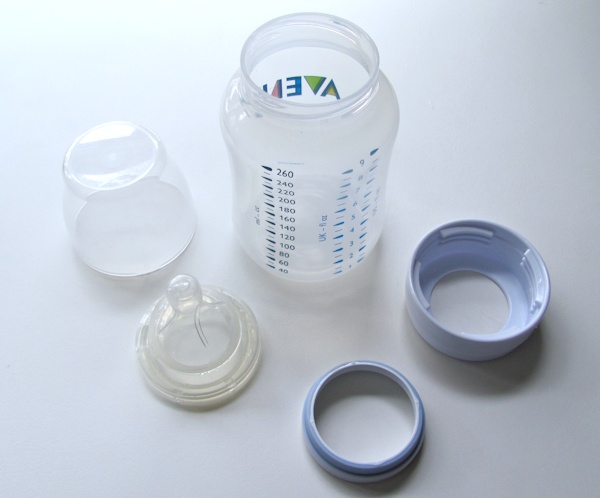
Avent Bottles Leaking
I read lots of Avent bottle reviews before deciding to use them, and one of the most frequently cited problems was leakage. After careful consideration, I chose to use Avent bottles despite the potential problems. I was very surprised one day when a bottle did leak, and it was every bit as bad as the reviewers made it out to be!
My son’s peaceful bottle feeding was interrupted as he was absolutely doused in formula pouring out the special air vent. I had purchased eight rather pricey bottles and was dismayed that I may have wasted my money. Between the money I spent and the fact that I really did like the bottles for a variety of reasons, I decided to search for a solution instead of tossing them out.
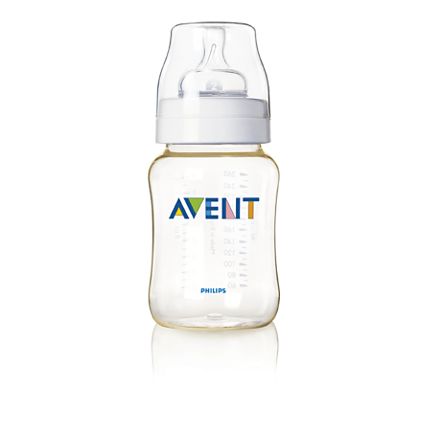
Avent introduced an extra part, the adapter ring, to cut down on the leakage problems that plagued their classic bottles years ago, but once in a while leaks still happen. I’ve found that the same advice that worked with the old bottles still holds true today.
To make sure that the bottle top is tightened “just right”, use the bottle cap to tighten the nipple ring in place. We all know that the bottle will leak if it’s not tight enough, but over-tightening can also present a problem as it can cause the seal to fail.
Here’s how to put Avent bottles together so you can enjoy worry-free and leak-free feeding:
Avent Bottle Assembly Instructions
1. For best results, both the nipple (or teat) and nipple ring should be wet before they are fastened together to ensure an airtight seal. I usually reassemble the rings and nipples together right after washing them so they’re ready to go when I need them.
2. Place the adapter ring with the blue side down into the neck of the bottle. Make sure it’s firmly in place and level with the top of the bottle. If you mix formula in the bottle, make sure you insert the adapter ring before adding formula powder, otherwise formula powder can come between the bottle neck and the ring, interfering with the seal.
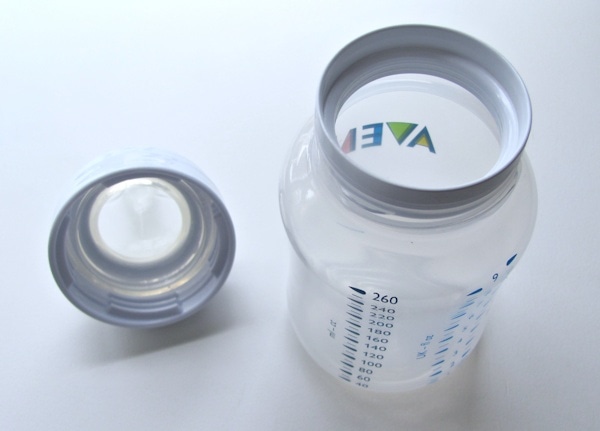
3. Place the nipple assembly over the bottle, but don’t tighten yet.
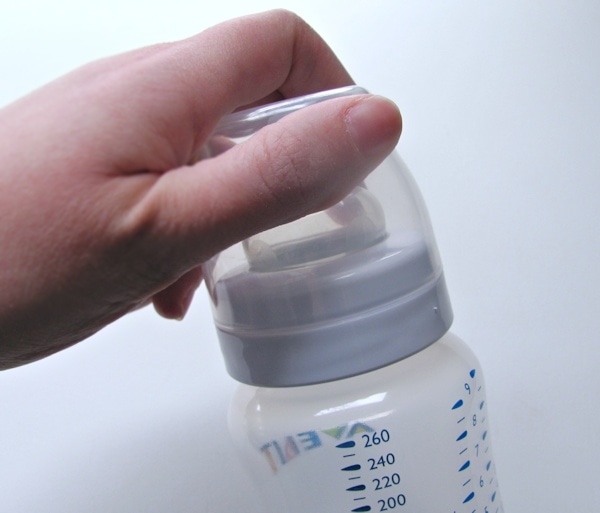
4. Next, pop on the clear plastic bottle cap. To screw the nipple onto the bottle, make sure you hold it by the cap and turn it by the cap only. As soon as the cap turns independently of the ring, the assembly is tight enough.
Simple, right? I was delighted to find this solution, and it has worked the vast majority of the time for me. On the rare occasion that a bottle does still leak, completely unscrewing the cap and refastening, repeating the steps above, will do the trick.
To further prevent leaks, it is best to avoid mixing formula in the bottle. It can certainly be done (and in fact I do it all the time), but small amounts of formula may splash out. If you do choose to mix formula in the bottle, just wrap a cloth around it as you’re shaking.
Until you get the hang of it, you may want to test the bottles prior to feeding them to your baby. Hold the filled bottle upside down for a few seconds, and then turn it right side up. A properly sealed bottle will not leak. Another indication that your Avent bottle is sealed properly will be the tiny air bubbles that appear (making a quiet “buzzing” sound) on the surface of the liquid near the nipple ring as you feed your baby; this indicates that the “Air Flex” system is working as it should.
Despite the somewhat quirky vent solution, I am still a big fan of Avent classic bottles. I think the simple design really does work, and unlike Dr. Brown bottles or other alternatives, there aren’t tiny parts to keep clean.

Hi JenSpends,
Thank you so much for giving proper instructions on how to use an Avent bottle! I thought my daughter was a gassy baby until I switched to Dr Browns bottles! I’ve been using them for a month now and my daughter is now gassy and she strains to get her gas out at times! I’m so glad that I kept my Avent bottles! Last night I didn’t get a chance to wash her Dr Brown bottles and wanting to hurry to feed my daughter I used an Avent bottle, so far I’ve used them for three feedings and what a different baby! Her gasses are coming out on their own without her having to strain, which makes her and I very happy! I’m going back to Avent bottles and now I can be for sure that I am using them properly! I guess I misunderstood gassiness for smelly toots! I feel that Dr. Browns bottles were not necessary afterall!
A Happy Mom
You’re so welcome Dominique! It’s very tough figuring babies out when they can’t tell you what’s wrong. Raising my son has definitely been a learning process for me! I loved the Avent bottles because they were so easy to clean, whereas Dr. Brown’s bottles had too many fussy little parts. I’ll probably buy Avent again when I have another baby. Thanks for visiting!
I purchased my 1st set back in 2011 in store at target and never had any issues with the 2nd and 3rd gen bottle advent made. I now have a 2nd child and I still use this bottle. It is extremely durable , well suited for an infant and most importantly there isn’t extra parts to clean. For as long as I’ve had this bottle it hasn’t leaked once expect the one time I forgot the adapter/anti colic ring. That should go into the bottle top before screwing on the screw ring with nipple. Don’t screw the top on too tight and your good to go. I guess any one complaining that the bottle leaks isn’t using it correctly as I’m a firm fan, so much so I bought the gift set for a friend of mine.
Apparently I’ve been assembling these all wrong. I wait for all of my parts to dry before I assemble. Now I know I need to make a better seal by keeping them wet. I also in a hurry would 0ull the parts out of the dishwasher and would not put a cap on it. I would just put my finger over the nipple. I soon realized this made formula go everywhere! And not theough the nipple. From under the cap. I will do what you explained now and forever! Thank you
Facing leak (between the adapter and teat) with avent new model (new model have no ring) and the philip service center said it do not have warranty. All the parts do not have external damage and force applied was light too, to me it is a quality issue. Anybody face the same issue?
Yes, we are using the new version with the “natural” nipple and have not had issues with leaking until we started using the 6+ month nipples. We have tried loose tightening, over tightening, dry and wet… some nipples just leak bad regardless of how we put the bottle together. It really is a pain after we had no issues for the first 6 months.
Yea..the step where you put the cap on the nipple assembly to screw it on doesn’t work. The adapter ring makes it impossible for it to stay…just saying.
Same problem. No matter how delicately I tighten the bottle it still leaks around the nipple. I switch to Playtex ventaire and I am much happier. No messy baby no clothes to change after no hidden milk in their neck rolls.
I stumbled upon this because I also am having this problem. These bottles were specifically chosen for our 1st child and all they do is leak. I can’t even use them. Who has time to deal with extra milk leaking, I am already trying to prevent it from going down his chin. I am very disappointed that there isn’t a fix. It’s not like we have a lot of options atm. Never purchasing again.
The leakage from around the nipple is horrible, mother’s deal with enough on a daily basis and should not have to worry about a bottle leaking especially when this is supposedly good quality.
Having the issue of leaking around nipple as a grandmother having to care for my new grandson as my daughter is having healing issues this is a big problem trying to take care of a 2 year old a newborn and my daughter I really don’t need added problems